
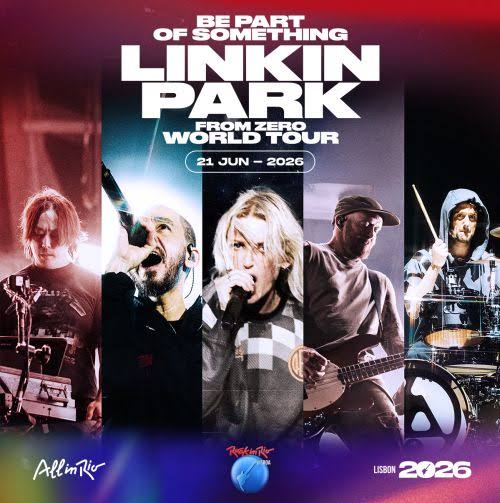
Friday Night Lights: Linkin Park at Rock in Rio 2026
 DJ Don Edwards
Friday Night Lights: Linkin Park at Rock in Rio 2026 Was One of the Greatest Comeback Performances in Modern Rock History
Some concerts are events. Some are milestones. And some are moments of such profound emotional and musical significance that calling them a concert feels inadequate, like describing a cathedral as a building. Linkin Park’s headline performance at Rock in Rio on June 21, 2026 belongs in that third category, and tonight Live Jam brings it to you as this week’s Friday Night Lights. If you were not in Rio de Janeiro that night standing among the hundreds of thousands of people who watched this unfold in real time, what you are about to experience is the next closest thing. And if you were there, you already know exactly what we are about to say.
The Weight of What This Performance Carried
Before a single note of music is played, before the Inception Intro begins its slow atmospheric build and the crowd starts to understand what it is about to witness, it is worth pausing to acknowledge what Linkin Park brought to that stage in Brazil and what it cost them to get there. The years between Chester Bennington’s death in 2017 and the band’s announced return with new vocalist Emily Armstrong in 2024 were not simply a hiatus. They were a period of genuine grief, public uncertainty, and the kind of creative paralysis that arrives when the voice most associated with your music is gone in the most permanent way possible. The decision to continue, to find a way forward, to rebuild and return to the stage, was not made lightly and was not universally embraced when it was announced. There were hard conversations, public debates among fans, and real questions about whether what the band was doing honored the past or complicated it.
Rock in Rio 2026 answered those questions with a ninety-minute performance that felt, at multiple points, like an act of healing conducted at stadium scale. This was a band that had earned its way back to one of the world’s biggest stages not by avoiding the difficulty of its history but by walking directly into it, night after night, song by song, and finding that the music still contained everything it always had.
The Opening: Building a World Before the First Chord
The performance opens not with a song but with an atmosphere. The Inception Intro unfolds slowly, deliberately, a cinematic construction of tension and anticipation that tells the audience something important before the band even appears: this is not going to be a casual evening. The intro runs for more than two minutes, and in the context of a festival stage where the impulse is almost always to get to the music as quickly as possible, the choice to use that kind of space is a confidence statement. Linkin Park knew exactly what they had, and they were willing to make 100,000 people wait for it.
When “The Emptiness Machine” arrives with its extended intro, the release of tension is immediate and physical. This track, one of the defining songs from the band’s post-return era, establishes Emily Armstrong’s presence on that stage as something real and earned rather than provisional. Her voice carries the song with a conviction that silences the remaining skeptics in the audience within the first minute, and the crowd’s response confirms that what is happening is not a tribute show or a nostalgia exercise. It is a band performing at the height of its powers.
The Early Sequence: Pulling From Every Era Without Apology
The move from “The Emptiness Machine” directly into “Lying From You” is a declaration of intent. This is a Meteora-era track, one of the songs that defined Linkin Park’s commercial peak in the early 2000s, and dropping it this early in the set makes clear that the band is not going to partition its history into a before and after. The catalog is the catalog, unified and continuous, and every era of it belongs on this stage equally.
“Crawling” follows, and this is the first moment of the night where the emotional weight becomes almost difficult to carry. This song was one of Chester Bennington’s most personal and exposed compositions, a piece of music about vulnerability and pain that he delivered with a transparency that few rock vocalists have ever matched. Hearing it performed live by this band, in this configuration, is not a simple thing, and the arrangement does not pretend otherwise. Armstrong delivers it with care and seriousness, honoring the emotional core of the song while making it her own, and the crowd’s response is enormous, the kind of collective sound that comes not just from fans who love a song but from people who feel something complicated and real in the moment of hearing it.
“Up From the Bottom” and “Somewhere I Belong” carry the set forward with a momentum that never fully relents. “Somewhere I Belong” has been a live staple for two decades, and it retains every bit of its crowd-moving power in the Rock in Rio setting. When the opening guitar riff hits in a stadium this size, you feel it before you hear it, and the collective recognition that ripples through a crowd of that scale is one of the great sensations available in live music.
The Middle Stretch: Ambition and Texture at the Highest Level
The Creation Intro arrives as a brief but essential moment of recalibration, pulling the crowd back into an atmospheric space before “The Catalyst” launches in its shortened festival configuration. Even without the third chorus and extended breakdown, this track is enormous, a song built for exactly the kind of open-air, massive-stage environment that Rock in Rio provides, and the crowd responds accordingly.
“Burn It Down” continues the momentum, and then comes one of the evening’s most unexpected and genuinely beautiful moments. A shortened, carefully arranged version of “Where’d You Go,” originally a Fort Minor track, appears as a transitional piece between the heavier material, and it works precisely because nobody fully anticipated it. The transition ending flows directly into the extended intro of “Waiting for the End,” and in that sequence of a few minutes, the band demonstrates the kind of setlist architecture that separates a great live show from a merely good one. These transitions are not accidents. They are compositional decisions, and they reward the audience’s attention.
“Two Faced” arrives with a Joe intro and an extended bridge that gives the song room to breathe and develop in ways that the studio version does not fully explore. In a live setting this large, that extra space becomes something tangible, a chance for the music to expand into the physical dimensions of the venue and fill it completely. “A Place for My Head” follows with the kind of aggressive, kinetic energy that reminds everyone in the crowd that this band emerged from the intersection of rock and hip-hop and never fully left that intersection, regardless of where the individual songs live in the catalog.
“IGYEIH” and then “One Step Closer” with its 2024 intro and the extended outro’s repeated chorus riff push the performance into its most physically intense territory, the point in the set where the crowd stops being an audience and becomes something more like a physical force. The extended outro of “One Step Closer” in particular is the kind of live arrangement decision that demonstrates how deeply this band has thought about what its songs can do when they are given permission to fully expand.
The Emotional Core: Piano, Loss, and the Songs That Carry the Most Weight
After the intensity of “One Step Closer,” the set enters what is perhaps its most emotionally demanding and artistically significant stretch. A brief Break and Collapse section creates space before the performance shifts entirely in texture and tone. “Lost,” delivered here in a stripped-back piano version featuring Mike Shinoda and Emily Armstrong, is the quietest and most exposed moment of the entire evening, and it is devastating in the best possible sense of that word.
This version of “Lost” removes every layer of production and arrangement and leaves only two voices and a piano, which means it leaves only the song itself and the feelings inside it. In the context of this particular band’s history, that kind of nakedness requires courage, and both Shinoda and Armstrong meet it fully. The crowd in Rio, which had been generating the kind of continuous noise that comes with 100,000 people occupying the same space, went quiet in a way that felt collective and intentional. That quality of silence at a festival of this size is extraordinarily rare, and it is one of the clearest signals available that something genuinely meaningful is happening on stage.
“Breaking the Habit,” which follows with a piano start and swirling intro arrangement, continues the emotional depth of this section before the set begins its movement back toward power and scale. This song, another of Bennington’s most personal and lyrically unguarded compositions, has always carried a particular weight in the context of live performance, and the piano-forward arrangement chosen for Rock in Rio gives it an intimacy that the full band version does not always achieve.
The Final Push: Building to the Peak
“Overflow” opens with an extended synth introduction that incorporates a passage from Metallica’s “One,” and the decision to bring that specific musical reference into this specific moment is worth noting. Both bands occupy a similar position in the rock pantheon: massively commercially successful, deeply rooted in the genre’s heaviest traditions, and more emotionally complex than their surface reputations sometimes suggest. The incorporation of that reference is not a gimmick. It is a statement about where Linkin Park sees itself in the broader history of rock music, and in the context of Rock in Rio, one of the great festivals of that tradition, it lands with the weight it deserves.
“What I’ve Done” and then “Numb” with its Numb/Encore introduction carry the set to its commercial and emotional peak. “Numb” remains one of the most broadly recognized rock songs of the past twenty-five years, a song whose melodic and lyrical simplicity contains a kind of universality that makes it feel personal to an enormous and diverse audience simultaneously. When it arrives in the Rock in Rio set, the crowd response is the kind of mass singalong that makes the scale of a 100,000 person festival suddenly feel intimate, because everyone in the field knows exactly the same words and is singing them at the same time.
“Heavy Is the Crown” arrives as one of the set’s defining statements about the present tense of this band, a song from the current era that holds its own in a setlist of catalog heavyweights without flinching. And then “Bleed It Out” closes the main set with an extended bridge that incorporates a verse from Fort Minor’s “There They Go” alongside an extended outro that does not so much end as accumulate, building and repeating until the energy in the crowd has nowhere left to go.
The Encore: Three Songs That Said Everything
The encore at Rock in Rio 2026 is built with the same architectural intelligence as the rest of the show. The Resolution Intro creates a final moment of breath and anticipation before “Papercut” arrives with its 2024 intro arrangement, bringing the set back to the very beginning of Linkin Park’s recorded history and reminding the crowd that the Hybrid Theory debut that produced this song changed the trajectory of rock music in a way that is still being felt a quarter century later.
“In the End” follows, and there is not much to say about what “In the End” does to a crowd that the crowd’s response at Rock in Rio did not already say better than any review could. This is one of the signature songs of a generation, a piece of music that is embedded so deeply in the cultural memory of everyone who grew up with it that hearing it performed live, at volume, in a stadium, with 100,000 other people, produces an emotional response that is almost impossible to describe in language and completely unnecessary to describe to anyone who has experienced it.
“Faint” closes the evening with an extended outro that gives the performance one final release of everything that has been building across the ninety minutes preceding it. The extended outro does not pretend to bring the evening to a graceful or subtle conclusion. It ends loudly, joyfully, and completely, which is exactly the right way for a performance of this magnitude to end.
What Rock in Rio 2026 Proved About Linkin Park
The questions that surrounded Linkin Park’s return are not fully settled by a single performance, however extraordinary. Questions about legacy, about continuity, about what it means to carry forward a body of music so deeply associated with a voice that is no longer present, are not answered in ninety minutes at a festival. But what this performance did answer, conclusively and without ambiguity, is whether this band can deliver at the highest level in a live setting. The answer that Rock in Rio returned was unambiguous. They can, they did, and the 100,000 people in the crowd knew it from the first notes of the Inception Intro through the final, sustained riff of “Faint.”
Emily Armstrong has not replaced Chester Bennington. Nobody could and nobody should try. What she has done is take on the extraordinary challenge of inhabiting a catalog of enormous emotional and cultural weight, bringing her own voice and her own presence to it, and serving the music with the seriousness and commitment it demands. Rock in Rio 2026 was the largest stage on which she has yet made that case, and the case was made convincingly.
Tonight on Live Jam’s Friday Night Lights, this is the performance we are honoring. Find somewhere great to listen, give it your full attention, and let one of the most significant live performances of 2026 do what it was made to do.