
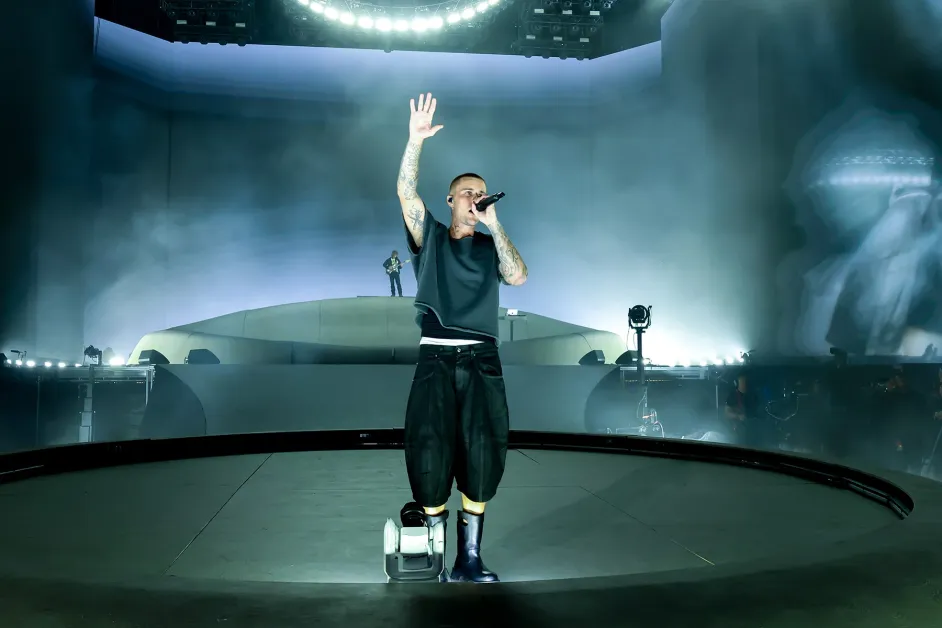
Friday Night Lights is Justin Bieber from Coachella Weekend 1!
 DJ Don Edwards
Justin Bieber’s Coachella Set Was One of the Best Live Performances of 2026 — and Now You Can Own It. There are festival moments that live and die in the desert, talked about for a week and then buried under the next news cycle. And then there are sets that feel genuinely historic the moment they’re happening — performances where something larger than a typical concert is taking place, where an artist and an audience find each other at exactly the right point in time and produce something neither of them could have made alone. Justin Bieber’s headlining performance on the Coachella main stage on Saturday, April 11, 2026 was the second kind. It wasn’t just a great festival set. It was a statement, a reconciliation, and a reintroduction — and now, thanks to Universal Music Group and Def Jam officially releasing SWAG: Live From Coachella Weekend II across all streaming platforms at the end of June, the rest of the world finally gets to experience what 100,000 people in the Indio desert felt that night.
This is Live Jam’s Friday Night Lights, and this week we’re going deep on one of the most compelling live releases of the year.
A Return That Meant Something
Context matters when you’re trying to understand why this performance hit as hard as it did. Bieber’s road back to the stage has been anything but linear. The years leading up to Coachella 2026 were defined by health challenges, public withdrawal, and a long stretch of silence that made many wonder whether they’d ever see him perform at this level again. When it was announced that he would headline the festival, the anticipation was enormous — but it was the kind of anticipation wrapped in genuine uncertainty. Would he be sharp? Would he be present? Would the voice be there?
The answer, delivered emphatically from the first note of the night, was yes to all three. What audiences witnessed that Saturday wasn’t a cautious comeback performance built around safe choices and nostalgia. It was a fully realized headlining set from an artist operating with something to prove — and the architecture of the show proved he’d thought deeply about exactly how to prove it.
The First Forty-Five Minutes: A New Era Announced on the Biggest Stage in American Festival Culture
Bieber opened with a declaration. The first forty-five minutes of the set were built almost entirely around material from his companion studio albums SWAG and SWAG II, records that had already signaled a significant artistic evolution before the Coachella announcement gave them their ultimate live showcase. Tracks like “ALL I CAN TAKE,” “SPEED DEMON,” and “FIRST PLACE” launched the set with a sonically dense, production-heavy intensity that immediately told the audience: this is not a greatest hits show. This is an artist introducing you to who he is now.
The choice was a risk by any reasonable festival standard. Coachella crowds are massive and eclectic, and the instinct for most headliners is to lead with familiarity. Bieber did the opposite — he bet on his new material to earn the crowd rather than inherit it — and the gamble paid off in full. The energy in the polo fields was electric from the moment those opening beats dropped, and the SWAG-era production gave the live show a weight and immediacy that translated beautifully across that scale of outdoor venue.
Then came one of the night’s most disarming moments. Midway through that opening stretch, the tempo shifted entirely. What had been a high-powered, sonically dense experience gave way to something raw and quiet, as Bieber moved into an acoustic-led interlude built around voice memos, stripped-back arrangements, and an emotional transparency that very few artists are willing to show in front of a crowd that size. “GLORY VOICE MEMO” arrived like a dispatch from somewhere private and unfiltered — a piece of music that felt like it was never supposed to leave the room where it was made. Paired with bare vocal performances over “ZUMA HOUSE” and “EVERYTHING HALLELUJAH,” this section of the set became one of the most talked-about moments of the entire Coachella weekend. Nobody expected it. Nobody forgot it.
The Nostalgia Medley: When the Crowd Became One Voice
Just when the emotional weight of the acoustic section had the crowd somewhere between awestruck and undone, Bieber pivoted again — this time reaching back into a catalog that belongs not just to him but to an entire generation of listeners who grew up with it. Starting at the fifty-minute mark with “BABY,” one of the best-selling singles in the history of recorded music, he launched into a high-energy, rapid-fire medley of his most beloved global hits, running through them at a pace that felt less like a set list and more like a shared act of remembrance.
“FAVORITE GIRL,” “THAT SHOULD BE ME,” “NEVER SAY NEVER,” and “CONFIDENT” came in one-to-two-minute bursts, back to back, each one triggering a fresh wave of recognition from a crowd that clearly had grown up with these songs embedded in their bones. The genius of structuring this section as a medley rather than full performances is that it kept the energy kinetic — there was no moment to settle, no dip between songs, just a continuous rush of familiarity that turned 100,000 strangers into a single organism singing the same words at the same time. It was the kind of shared experience that reminds you why live music exists at all.
The Guest Appearances: Coachella’s Desert Brought Out Some of Music’s Best
Great headlining sets have great guest moments, and Bieber’s Coachella performance delivered some of the night’s most memorable surprises through a series of carefully chosen collaborators who didn’t just appear — they contributed something real to the arc of the show.
The Kid LAROI joined the stage to deliver their era-defining global hit “STAY” in what became one of the loudest crowd responses of the entire night. This song has been everywhere since its release, but hearing it performed live by both of the artists who made it, on the biggest outdoor stage in American music, gave it a weight and electricity that no streaming version can fully replicate.
Later in the set, Dijon emerged for a performance of “DEVOTION” that shifted the emotional temperature of the show entirely — a moment that felt intimate and almost spiritual against the backdrop of that enormous desert stage. Dijon is one of the most distinctively gifted vocalists working in any genre right now, and his appearance alongside Bieber felt like a genuine artistic statement rather than a calculated marketing moment.
Then came the afrobeats section that arguably generated the biggest pure energy spike of the night. Wizkid and Tems arrived together for a performance of the viral remix of “ESSENCE” that immediately transported the entire crowd — there is no other way to describe what that song does to an audience when performed live at full scale. They followed it with “I THINK YOU’RE SPECIAL,” and the combination of those two performances back to back represented one of the most genuinely joyful stretches of live music at any festival anywhere this year.
The closing guest was perhaps the most unexpected and, for many in the crowd and now among listeners of the live album, the most lingering in memory. Mk.gee — the acclaimed indie guitarist whose reputation has grown enormously in recent years among listeners who value texture, restraint, and genuine musicianship — joined Bieber to close out the entire concert with an atmospheric live performance of “DAISIES.” It was the kind of ending that no algorithm would have predicted and that no amount of advance planning could have fully engineered. It just worked — quietly, beautifully, and completely.
SWAG: Live From Coachella Weekend II — The Album Itself
What Universal Music Group and Def Jam have packaged and released as SWAG: Live From Coachella Weekend II is something rarer than a typical live album. Most festival live recordings feel like documentation — a record that something happened. This one feels like the event itself. The production choices in the mix capture not just Bieber’s vocal performance but the physical reality of a Coachella-scale show: the crowd noise, the space between notes, the way the desert air carries sound differently at night, the energy between performers during the guest segments.
For listeners who were there, it functions as a perfect memory object. For those who weren’t, it functions as the next best thing to being there — which is a genuine achievement, because most live albums don’t manage to do that. This one does.
The sequencing of the album mirrors the set with care, meaning you experience the full emotional architecture of the night in order: the SWAG-era power opening, the disarming acoustic middle section, the euphoric nostalgia medley, the guest collaborations, and finally that quiet, atmospheric close with Mk.gee. Listened to from beginning to end, it runs like a very well-written piece of narrative — a story about who Justin Bieber is in 2026 that happens to be told in music rather than words.
Why This Release Matters Beyond the Obvious
It would be easy to cover this release as a straightforward story about a major pop star having a great night at a famous festival. But the deeper story here is about what this kind of performance means at this particular moment in music culture. We are living through an era where live performance has reasserted itself as the primary measure of an artist’s legitimacy. Streaming numbers matter, chart positions matter, but the question audiences are increasingly asking is: can you do this live? Can you carry a hundred thousand people for ninety minutes and make them feel something real?
Justin Bieber answered that question at Coachella 2026, and the answer was unambiguous. Whatever anyone thought going in — whatever doubt existed about where he was as a performer, as an artist, as a person present enough to give a crowd this kind of night — the set dissolved it. This was a great live performance by any standard, measured against any era, by any artist.
The live album preserves that answer for anyone who needs to hear it.
📻 Tonight on Live Jam Radio: Don Plays Live Zappa — Five Hours, Every Tuesday at 10PM EST
Speaking of great live performances worth preserving and revisiting — don’t forget that every Tuesday night at 10PM EST, Don Plays Live Zappa takes over the airwaves for five straight hours of live Frank Zappa recordings. Deep cuts, legendary concert moments, rare performances pulled from the archive, and music that rewards every minute of serious listening. It’s the kind of radio experience that doesn’t exist anywhere else, and it’s on every week. Tune in Tuesday and let one of music’s greatest live catalogs do what it was always meant to do.