
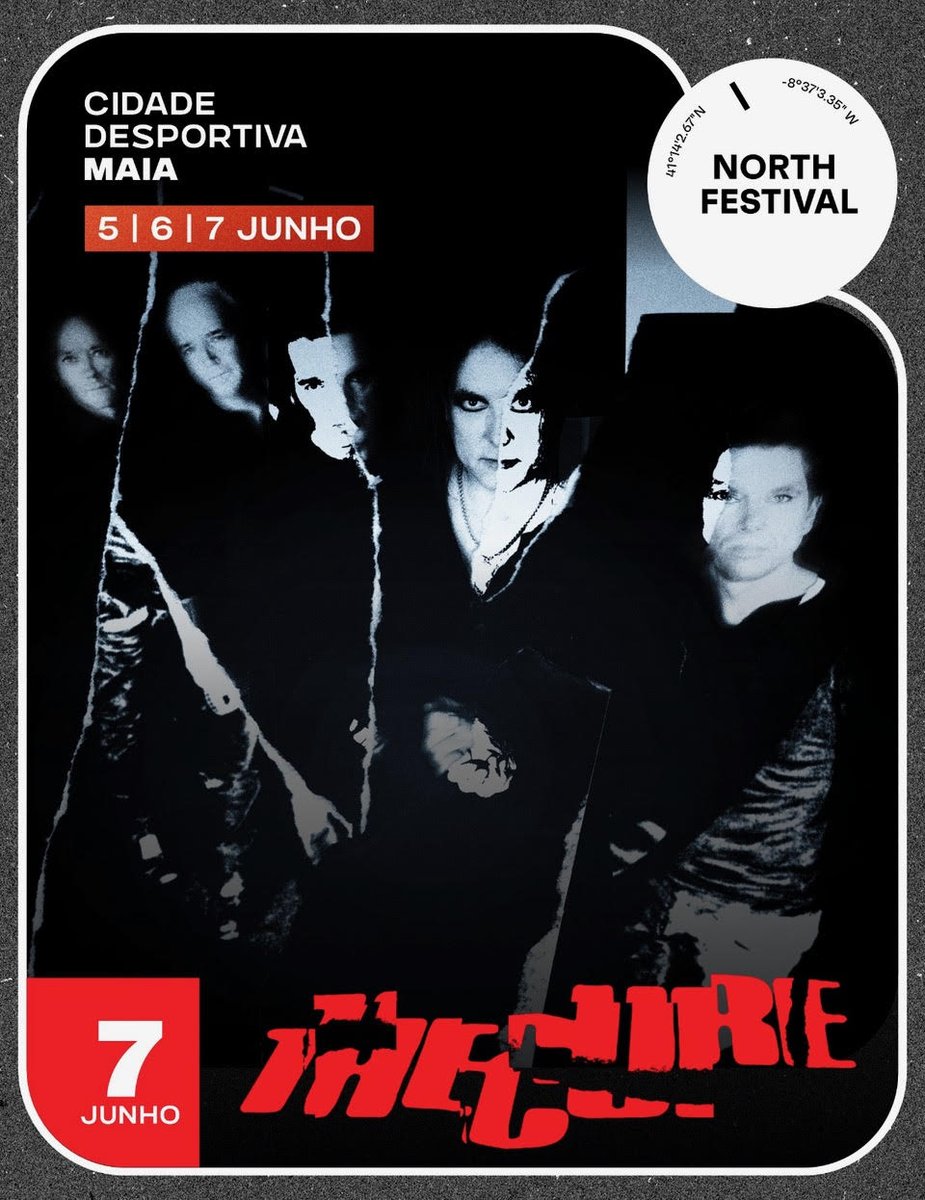
Friday Night Lights: The Cure at North Festival Porto 2026
 DJ Don Edwards
Friday Night Lights: The Cure at North Festival Porto 2026 Was a Two-and-a-Half-Hour Gift to Everyone Who Has Ever Loved This Band
There are performances that remind you why you fell in love with live music in the first place, shows where the weight of a catalog, the genius of a band, and the electricity of an audience come together under an open sky and produce something that feels genuinely unrepeatable. The Cure’s headline set at North Festival in Porto, Portugal on June 7, 2026 was that kind of performance, and tonight it takes its place as the Live Jam Friday Night Lights feature with a depth of justification that very few shows in recent memory can match. This was not simply a great concert by a legendary band. It was a two-and-a-half-hour journey through one of the most singular and emotionally vast catalogs in the history of alternative music, punctuated by two genuinely historic moments that no amount of advance speculation could have fully prepared even the most devoted Cure fan to experience.
The Band, the Setting, and What the Summer Shows 2026 Tour Represents
Robert Smith has spent more than four decades leading The Cure through one of the most consistent and creatively remarkable careers in all of popular music, and the Summer Shows 2026 tour represents the band operating in a mode that has become its most natural and authoritative: the extended, generous, career-spanning live performance that treats the catalog not as a greatest hits exercise but as a living body of work worth exploring from every angle on any given night. The North Festival in Porto provided the ideal backdrop for this approach. Portugal’s relationship with music that carries emotional depth and atmospheric complexity is well documented in its own indigenous musical traditions, and a crowd gathered in Porto for a festival headlined by The Cure is a crowd that arrived prepared to feel something serious. The band met that expectation and then exceeded it by a considerable margin.
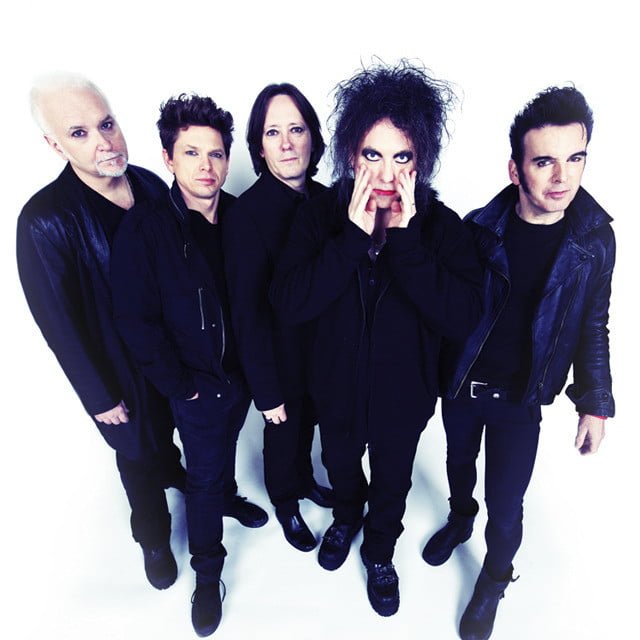
Simon Gallup on bass, Jason Cooper on drums, Roger O’Donnell on keys, Reeves Gabrels on guitar, and Eden Gallup completing the lineup alongside Robert Smith formed a band in 2026 that plays with the kind of intuitive synchrony that only comes from musicians who have spent real time inside this music together. The textures that define The Cure’s best recorded work, those layered guitar figures, the low-end drive that Gallup brings to the band’s darker material, the atmospheric keyboard work that gives so many of these songs their sense of infinite interior space, were all present in Porto and all translated to a festival stage with a fidelity that reminded the audience why this music has never needed to be remade or reimagined to remain vital.
“Alone” and the Opening That Set the Tone for Everything That Followed
The decision to open with “Alone,” the lead track from the band’s 2024 album Songs of a Lost World, was a statement about what kind of night this was going to be. This is not an easy song, not an obvious crowd-pleaser in the way that several dozen other Cure tracks could claim to be, and choosing it as the first moment of a festival headline set signals immediately that The Cure are not interested in taking the path of least resistance. “Alone” opens with a deliberateness and a weight that asks the audience to meet it rather than simply receive it, and a crowd willing to do that is a crowd that will get the full version of what The Cure are capable of offering.
The seven-plus minutes that “Alone” occupies in the Porto set are a declaration. They say: we are going to take our time tonight, we are going to give you the full experience of what these songs contain, and we are not going to apologize for any of it. By the time the song resolves and the first notes of “Pictures of You” begin, the audience has already been transported somewhere distinct from the ordinary festival experience, somewhere quieter and more interior, and the enormity of “Pictures of You” arriving in that space is almost overwhelming.
The Main Set: A Cathedral Built Song by Song
“Pictures of You” is, by any serious measure, one of the greatest songs ever written about memory and loss, and hearing it performed live in a festival setting under the Portuguese evening sky gives it a physical dimension that no studio recording can fully approximate. The guitar figures that open the song are so deeply embedded in the emotional memory of an entire generation of listeners that their first notes produce a response that is closer to recognition than excitement, the particular feeling of encountering something you have always known. Smith’s vocal delivery in Porto is exactly what it needs to be, present and affecting without being performative, and the crowd’s response throughout the song reflects a depth of engagement that goes beyond fandom into something more personal.
“High” and “A Night Like This” carry the set forward through material that spans the band’s recorded history without any sense of inconsistency or tonal disruption, because The Cure’s catalog, diverse as it is across genre and decade, shares an underlying emotional DNA that makes these transitions feel natural rather than forced. “Lovesong,” which arrived in 1989 as the band’s only American number one single and has lost none of its devastating simplicity in the decades since, produces another of the set’s major collective moments, the kind of mass singalong that happens not because an audience has been cued to participate but because the song makes participation feel involuntary.
“The Last Day of Summer” is a less commonly performed track that rewards the audience members who know it deeply, and its placement here speaks to the curatorial intelligence that Robert Smith brings to Cure set construction. This is not a song chosen because it is expected. It is chosen because it belongs in this particular sequence on this particular night, and in that context it carries an emotional weight that a more obvious choice would not have provided. “Burn,” from the soundtrack to The Crow, follows as one of the most dramatically powerful songs in the band’s catalog, a track that sounds as if it was written specifically for the scale of an outdoor festival stage, and the Porto performance confirms that impression fully.
“Fascination Street” is the moment in the set where the band’s darker, bass-driven side comes fully to the front, and Simon Gallup’s playing here is definitive. This is a song built around its low end, around the particular quality of tension that Gallup can create simply through the way he approaches a note and what he does with the space around it, and in a live setting of this scale that tension becomes physical, something you feel in your chest before you process it intellectually. The crowd response builds throughout the song in a way that reflects genuine listening rather than simply waiting for the chorus, which is the highest compliment you can pay to a festival audience.
“alt.end,” “Push,” “Mint Car,” “In Between Days,” and “Just Like Heaven” carry the set through a stretch that covers the full tonal range of what The Cure can be in a single evening, from the reflective and melancholic to the bright and joyful to the anthemic. “Just Like Heaven” in particular is one of those songs where the gap between its apparent simplicity and its actual emotional complexity is so vast that each live performance reveals something the previous one left unexplored. In Porto, the song arrives just past the fifty-nine-minute mark and lands with the force of something perfectly timed, the right song in the right sequence at the right moment in the evening.
The Historic Moment: “Treasure” Returns for the First Time Since 2013
And then, at one hour and three minutes into the performance, something happened that no amount of reasonable expectation could have fully prepared a Cure fan to witness. “Treasure” began. For the first time since 2013, The Cure performed this song in a live setting, and the reaction from fans in the crowd who understood what they were hearing was immediate and profound. Thirteen years is a long time for any song to remain unperformed, particularly a song from the band’s catalog that carries the emotional specificity and architectural beauty that “Treasure” does, and its return in Porto felt less like a set list choice and more like the opening of a door that everyone had assumed was permanently closed.
The performance of “Treasure” in this context is everything you would want it to be. Smith delivers it with the care of someone who understands exactly how long people have been waiting to hear it again, and the band plays it with a precision and sensitivity that suggests this was not a decision made lightly or rehearsed casually. For the fans in Porto who experienced this live, it was one of those concert moments that becomes a permanent part of personal music history, the kind of thing you spend years describing to people who weren’t there.
“Want” and the extraordinary “From the Edge of the Deep Green Sea” follow, with the latter at nearly eight and a half minutes representing one of the set’s most fully realized live performances, a song that is architecturally massive and emotionally relentless and that The Cure deliver in Porto as if it is the only song they have ever written. The closing track of the main set, “Endsong,” runs for over fourteen minutes and functions as a kind of sustained meditation, the band holding a single emotional and atmospheric space for an extended period and asking the audience to stay inside it. This is not festival behavior in any conventional sense. It is an act of artistic courage, and it works.
The Encores: Three Returns That Completed the Evening
The first encore opens with the night’s second historic moment, arriving even more unexpectedly than the first. “In Your House” began, and for fans tracking the band’s live history, the significance was immediate: this was the first live performance of “In Your House” since 2011, a fifteen-year gap in the song’s live existence that ended in Porto on a June evening in 2026. The song dates to the band’s earliest creative period, to a time when The Cure were still building the language that would eventually produce everything that followed, and hearing it performed live in 2026 is a reminder that the foundation of this catalog goes deeper than most listeners have had the opportunity to fully explore.
“M” and “Play for Today” continue the first encore’s excavation of the band’s early catalog, two tracks from Seventeen Seconds that remind the audience how fully formed and how singular The Cure’s vision was from almost the very beginning. And then “A Forest” closes the first encore in the only way appropriate: completely and at full volume, the song’s iconic bass line and guitar figure building through its extended live arrangement into one of the most recognizable and physically affecting moments in all of alternative rock. “A Forest” in a live setting is an experience that demands physical response, and the crowd in Porto provided it.
The second encore brings an entirely different emotional temperature, and the contrast with what preceded it is one of the most intelligent structural decisions of the entire performance. “Lullaby” opens this final section with its theatrical, slightly menacing pop sensibility, and “Wrong Number” follows with its dense, layered production translated effectively to the live setting. “The Walk” and “The Lovecats” continue the second encore’s more playful and energetic tone, two tracks from the era when The Cure were demonstrating that they could operate in the territory of pure pop joy without abandoning any of the depth and complexity that distinguished them from every other band working at the time.
“Friday I’m in Love” arrives near the close of the second encore and does exactly what it has always done, which is to generate a kind of uncomplicated, full-throated joy in any crowd that hears it. This is a song that has no cynicism in it, no irony, no reserve, and in the context of a set that has spent two hours and more exploring the full emotional spectrum of this catalog, its arrival feels like a reward. “Close to Me” and “Why Can’t I Be You?” continue the celebratory mood of the second encore’s closing stretch before “Boys Don’t Cry” ends the evening in the most complete and satisfying way possible.
“Boys Don’t Cry” as a closing anthem is a choice that says something important about how Robert Smith understands his band’s legacy. This is one of the earliest songs in the catalog, a piece of music written before The Cure had fully become what they would become, and ending an evening of this scale and ambition with it is a gesture of humility and connection, a reminder that whatever the band has accomplished across four decades, it all began here, with songs this direct and this honest about the experience of being human. The crowd in Porto sang every word of it, and the evening ended.
What the Porto Performance Tells Us About The Cure in 2026
A band that can open a set with “Alone” and close it with “Boys Don’t Cry,” that can include the first live performance of a song in thirteen years and the first live performance of another in fifteen years within the same evening, that can sustain a two-and-a-half-hour performance across two encores without a single moment of padding or obligation, is a band operating at a level of creative health and artistic seriousness that demands recognition. The Cure in 2026 are not a legacy act going through the motions of their catalog for an audience that simply wants to hear the songs they already know. They are a functioning, artistically alive band with a new record that holds its own against everything they have made before it, and they are taking that full body of work to stages across Europe with a generosity and an ambition that should make anyone with the opportunity to see them this summer understand clearly what is at stake.
The North Festival Porto performance is one of the finest live documents this band has produced, and tonight on Live Jam’s Friday Night Lights, it belongs to you. Turn it up, give it the full two and a half hours it deserves, and let one of the genuinely great catalogs in the history of popular music do what it has always done best.