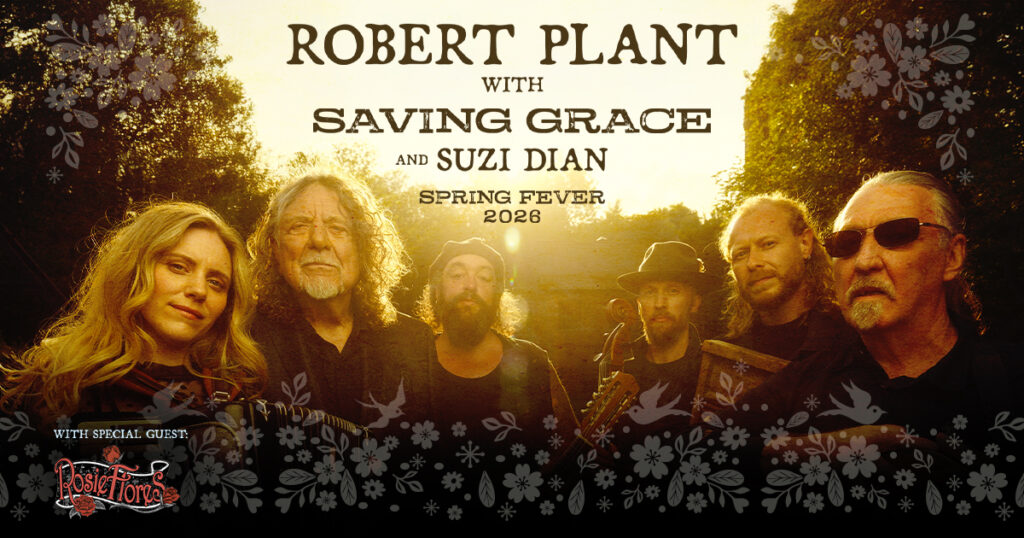
There are very few artists in the history of modern music capable of carrying an entire era with them every time they walk onto a stage. Fewer still can disappear from the touring circuit for stretches of time, return without relying on nostalgia, and instantly remind audiences why their voice, presence, catalog, and mystique continue transcending generations. Robert Plant remains one of those rare figures. As he arrives in South America to launch another ambitious run of performances with Saving Grace, the larger story unfolding is not simply about another tour announcement. It is about endurance, artistic reinvention, and the continued cultural dominance of the music born from the universe of Led Zeppelin.
For Live Jam, this latest chapter arrives at the perfect moment. Across classic rock radio, vinyl communities, streaming platforms, collector circles, and live performance culture, interest surrounding the Zeppelin legacy has quietly intensified again in 2026. The appetite for archival releases, live recordings, rare photography collections, historical books, and deep-dive concert analysis continues growing at a remarkable pace. Younger audiences are discovering the group through streaming and social media clips while longtime fans are reconnecting with performances that helped define the architecture of arena rock itself. That renewed momentum is precisely why the return of Robert Plant to the international stage feels far bigger than a routine touring cycle. It feels like another living continuation of one of the most important catalogs ever created.
Plant’s latest tour with Saving Grace opens in Argentina following his arrival in Buenos Aires, where he was recently photographed attending the legendary Señor Tango dance performance ahead of opening night. The appearance itself immediately generated conversation throughout fan communities because Plant has always carried an unusual relationship with world music traditions, folk culture, roots performance, and regional musical identity. That curiosity has become a defining characteristic of his post-Zeppelin career. Rather than endlessly recreating the past, Plant has spent decades reshaping it, filtering blues, folk, Americana, African rhythms, country textures, and acoustic experimentation into a constantly evolving live experience that refuses to become static nostalgia.
May 2026: South American Leg
This block of dates features a mix of high-profile theater performances and major music festival appearances across Argentina and Brazil.
- May 14, 2026: Córdoba, Argentina – Plaza de la Musica
- May 16, 2026: Rosario, Argentina – Metropolitano Rosario
- May 19, 2026: Porto Alegre, Brazil – Auditorio Araujo Vianna
- May 21, 2026: Rio de Janeiro, Brazil – Vivo Rio Hall
- May 24, 2026: São Paulo, Brazil – C6Fest at Ibirapuera Park [1]
June & July 2026: European & Mediterranean Leg
Following a brief break, the tour shifts gears to historic outdoor arenas and European summer festivals across Croatia, Turkey, Bulgaria, and Greece. [, 2]
- June 20, 2026: Šibenik, Croatia – Saint Michaels Fortress (Sold Out)
- June 21, 2026: Šibenik, Croatia – Saint Michaels Fortress (Sold Out)
- June 22, 2026: Šibenik, Croatia – Saint Michaels Fortress
- July 2, 2026: Istanbul, Türkiye – Cemil Topuzlu Open Air Theatre
- July 3, 2026: Ankara, Türkiye – Bilkent Odeon
- July 6, 2026: Plovdiv, Bulgaria – Roman Theatre of Philippopolis
- July 9, 2026: Athens, Greece – Lycabettus Theatre
- July 11, 2026: Halkidiki, Greece – Sani Festival
What to Expect From the Show: Rather than a traditional arena rock spectacle, these intimate performances center heavily around acoustic arrangements, deep folk storytelling, and rich vocal harmonies. The 10-song setlist draws heavily from the Saving Grace debut studio effort, treating audiences to reinterpreted roots music, acoustic covers, and stripped-down arrangements of traditional standard tracks like “Gallows Pole”
That artistic philosophy is precisely why the Saving Grace project has resonated so strongly with audiences internationally. Instead of attempting to recreate the explosive hard rock force of Zeppelin’s peak years, Plant has leaned into atmosphere, storytelling, emotional phrasing, and reinterpretation. The result is a live performance experience rooted less in spectacle and more in musical intimacy, arrangement dynamics, and interpretive depth. For longtime listeners, it offers another dimension to songs that have already survived generations. For newer audiences, it introduces Plant not merely as a legacy vocalist, but as a still-evolving performer deeply invested in musical exploration.
The current tour schedule reflects the growing international demand surrounding these performances. Following multiple nights in Buenos Aires, Plant and Saving Grace will continue through Córdoba and Rosario before heading into Brazil for performances in Porto Alegre, Rio de Janeiro, and São Paulo, including an appearance at the increasingly respected C6 Fest. The summer stretch then moves into Europe with dates in Croatia, Turkey, Bulgaria, and Greece, culminating in appearances at internationally recognized festivals that continue embracing artists capable of bridging heritage and innovation simultaneously.
What makes this run especially fascinating is the timing. Plant’s ongoing momentum is being fueled not only by touring, but also by renewed collector enthusiasm surrounding his recent Record Store Day release, All That Glitters. Limited to only 3,500 copies, the EP has continued climbing both the Official Vinyl Singles and Official Physical Singles charts long after many expected the release cycle to cool down. In an era dominated by algorithmic listening and disposable streaming behavior, that continued performance says something important about the current state of physical music culture. Fans are still actively seeking tactile experiences, collectible pressings, and curated releases connected to artists whose catalogs carry emotional and historical weight.
The vinyl resurgence has become particularly intertwined with the Zeppelin ecosystem because few bands benefit from analog reverence the way Led Zeppelin does. Their records were designed to breathe through speakers, shake rooms, and overwhelm listeners with sonic depth. Entire generations of audiophiles continue using Zeppelin albums as benchmark recordings to test turntables, amplifiers, headphones, and speaker systems. That legacy remains deeply embedded in collector culture, which helps explain why any new Plant-related vinyl release immediately generates demand far beyond simple nostalgia purchasing.
At the same time, the broader Led Zeppelin universe continues expanding through publishing, archival photography, and historical retrospectives that are helping preserve one of rock music’s most studied live eras. Several major releases arriving later this year will likely intensify that conversation even further. Former Jimmy Page and Robert Plant manager Bill Curbishley is preparing to release his memoir To Be Or Not To Be: A Life in Music, a book expected to offer significant insight into the management, touring, and business realities behind some of rock’s largest artists and most pivotal moments. Shortly afterward, Paul Brannigan’s Valhalla!: The A to Z of Led Zeppelin is scheduled for publication, promising another expansive examination of the mythology, history, recordings, and cultural footprint surrounding the band. Then later in the year, Led Zeppelin on Tour, 1969–1975: The Carl Dunn Photo Archive is expected to provide fans with another rare visual deep dive into what many still consider the most commanding live rock band in history.
That ongoing fascination with Zeppelin’s live years is entirely understandable because the band fundamentally changed audience expectations for concert performance. They expanded the idea of scale. They transformed improvisation into arena-level spectacle. They blurred the lines between blues, hard rock, psychedelia, folk, progressive experimentation, and sheer sonic violence. Most importantly, they built a mythology around live performance itself. A Led Zeppelin concert was never marketed as merely another stop on a tour schedule. It became an event. A shared experience. A cultural occurrence capable of generating stories that survived for decades afterward.
That spirit continues directly through Live Jam and through programs like the Get the Led Out Live radio show, which has become essential listening for audiences still obsessed with the raw electricity of Zeppelin’s concert years. Airing every Wednesday night beginning at 10PM for three uninterrupted hours, Get the Led Out Live delivers deep explorations into some of the most legendary performances ever captured from the band’s historic career. Rather than functioning as a simple greatest-hits format, the show dives directly into the improvisational power, marathon performances, alternate arrangements, and explosive stage chemistry that turned Led Zeppelin into a live phenomenon unlike anything before or since.
For serious Zeppelin fans, live recordings have always represented an entirely separate universe from the studio catalog. Songs evolved nightly. Tempos shifted. Solos stretched into entirely new musical territories. Acoustic passages emerged unexpectedly. Blues medleys appeared without warning. Entire performances could feel unpredictable, dangerous, loose, and transcendent all at once. That unpredictability is precisely what keeps audiences endlessly returning to archival Zeppelin recordings decades later. No two nights were identical. No performance felt manufactured. The imperfections themselves became part of the mythology.
That reality is increasingly important within today’s modern concert ecosystem where precision, synchronized visuals, backing tracks, click tracks, and hyper-controlled production environments often dominate arena touring. Zeppelin represented the opposite philosophy. Risk was part of the experience. Improvisation was expected. Chaos occasionally became brilliance. The audience never fully knew what might happen next. That human volatility created a level of authenticity that remains almost impossible to replicate in contemporary live production culture.
The continued fascination with Robert Plant also speaks to a larger truth about longevity in music itself. Most artists tied to iconic bands spend their later careers trapped by expectation. Plant avoided that fate by refusing to become imprisoned by his own mythology. His willingness to experiment, collaborate, reinterpret, and evolve preserved his credibility in ways few legacy artists manage successfully. Instead of chasing the past endlessly, he learned how to converse with it while still moving forward artistically.
That balance is what makes these current performances so compelling. Audiences attending Saving Grace concerts are not simply watching a classic rock vocalist revisiting old material. They are witnessing one of rock history’s most important voices continuing to reinterpret his musical identity in real time. That distinction matters. It transforms the experience from tribute into evolution.
It also reinforces why the Led Zeppelin legacy continues operating differently from most classic rock institutions. Zeppelin never truly became comfortable museum culture. Even decades later, the music still feels massive, dangerous, emotional, unpredictable, and culturally alive. Younger musicians continue citing the band as foundational influence across hard rock, metal, blues rock, folk rock, alternative music, progressive music, and even modern experimental genres. Producers still analyze the recordings. Guitarists still chase the tones. Drummers still study the power and groove dynamics pioneered by John Bonham. Vocalists still attempt to understand the range and phrasing Plant delivered during the band’s peak years.
That permanence is why every new Plant appearance, release, interview, archive project, or tour immediately reignites conversation throughout the music world. The Zeppelin story never fully fades because the music itself never stopped expanding through generations. Every year creates another wave of discovery.
For Live Jam, that enduring connection between live performance history and modern audience obsession remains central to the culture we celebrate every day. Whether through rare concert broadcasts, archival analysis, vinyl culture, touring updates, or marathon radio experiences like Get the Led Out Live, the larger mission remains preserving the emotional electricity that only truly great live music can create.
And as Robert Plant once again steps onto stages across South America and Europe, that electricity returns with him. Not as nostalgia. Not as a legacy cash-in. But as another living continuation of a musical force that still refuses to disappear.