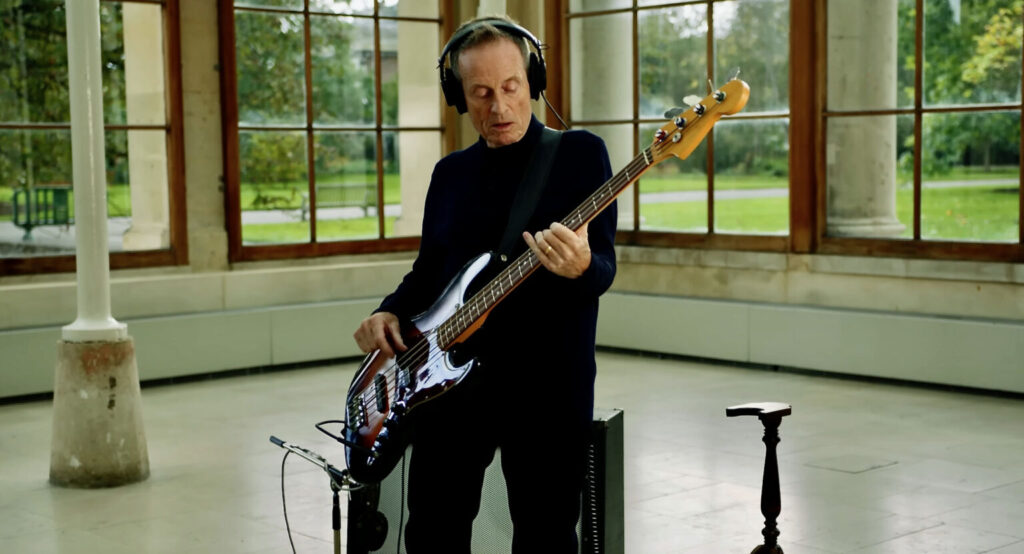
At the center of this broader mission is a renewed focus on legacy artists whose influence continues to expand long after their most visible years, and few figures embody that evolution more completely than John Paul Jones. While widely recognized as the bassist and multi-instrumentalist behind Led Zeppelin, Jones has spent the last several decades quietly constructing a second career that moves far beyond the expectations typically attached to classic rock icons. What has emerged is not a nostalgic extension of his earlier work, but a deliberate and sophisticated pivot into contemporary composition, avant-garde structure, and orchestral experimentation.
That trajectory is now reaching a new peak with his long-developing opera The Ghost Sonata, a project he has described as a defining work—one that has taken shape over more than a decade of composition and refinement. Drawing from the 1907 play by Swedish dramatist August Strindberg, the opera leans into surrealism and psychological depth, abandoning any expectation of traditional rock structure in favor of a fully realized classical framework. Yet even within that environment, Jones continues to innovate, incorporating advanced electronic systems and unconventional instrumentation to create a sonic atmosphere that aligns with the work’s darker, spectral themes. With a targeted performance window at the Helsinki Festival in late summer 2026, the project stands as a statement of intent: a veteran musician operating at the highest conceptual level, unconcerned with repetition and fully invested in forward movement.
That same commitment to exploration is evident in his recently premiered song cycle Her Kind, introduced in early 2026 at London’s Purcell Room. Built around the poetry of Anne Sexton, the work moves through themes of identity, voice, and perspective with a modern compositional approach that prioritizes tension, space, and emotional precision. Written specifically for the Treske String Quartet and soprano Héloïse Werner, the piece reflects Jones’s deliberate alignment with contemporary classical performers—artists who are not bound by legacy expectations, but instead operate within the same forward-looking mindset that now defines his own work.
At the same time, an entirely different dimension of his career is re-emerging through archival discoveries that underscore just how much material has remained out of public reach. Recent findings indicate the existence of more than twenty unreleased or partially completed recordings spanning multiple decades of Jones’s work. These include experimental electronic compositions created in his private studio, extended improvisational recordings from his duo project Sons of Chipotle with Finnish cellist Anssi Karttunen, and—perhaps most notably for rock audiences—previously unheard material from the 2009 sessions of Them Crooked Vultures, the collaborative project with Dave Grohl and Josh Homme. These recordings are not simply curiosities; they represent a substantial extension of a catalog that continues to evolve in multiple directions simultaneously.
Within the Live Jam framework, this kind of multidimensional artistry is not treated as an outlier—it is the standard. The platform’s programming reflects a deep understanding that live music culture is not linear. It is a network of influences, reinterpretations, and ongoing conversations between artists across generations. By presenting this material in a live context, Live Jam reinforces the idea that even the most historically significant catalogs are not fixed; they are living systems that gain meaning through performance.
This philosophy is amplified further through signature programming that anchors the weekly schedule, none more definitive than Get the Led Out Live. Airing every Wednesday night beginning at 10PM for three uninterrupted hours, the show delivers a focused immersion into the live legacy of Led Zeppelin at their most powerful. These are not condensed highlights or retrospective summaries; they are extended performances drawn from the band’s most iconic concerts, presented in a way that preserves the scale, intensity, and improvisational edge that defined their live identity.
The importance of that format cannot be overstated. Led Zeppelin’s studio recordings, while foundational, only tell part of the story. It was on stage where their music expanded—where songs stretched beyond their recorded forms, where dynamics shifted unpredictably, and where the interplay between band members created moments that could never be replicated. By dedicating a three-hour block to that material each week, Live Jam is not simply revisiting history; it is recontextualizing it for an audience that understands the value of hearing these performances in their full, unedited form.
What emerges from this approach is a listening experience that feels immediate, even when the recordings themselves are decades old. The energy translates. The risk translates. The sense of possibility—of not knowing exactly where a performance will go next—remains intact. That is the defining characteristic of live music at its highest level, and it is the standard that Live Jam continues to uphold across its entire platform.
In 2026, as the boundaries between genres continue to blur and the demand for authentic, performance-driven content grows, Live Jam stands in a position of clarity. It does not chase trends. It does not dilute its focus. Instead, it doubles down on the core principle that has always separated meaningful musical experiences from disposable ones: the understanding that the most important music is not just heard, but lived in the moment it is created.
For listeners who recognize that distinction, the value is immediate. Live Jam is not just a station. It is an active conduit for the past, present, and future of live music—delivered with precision, depth, and a level of editorial intent that sets it apart in an increasingly crowded landscape.