
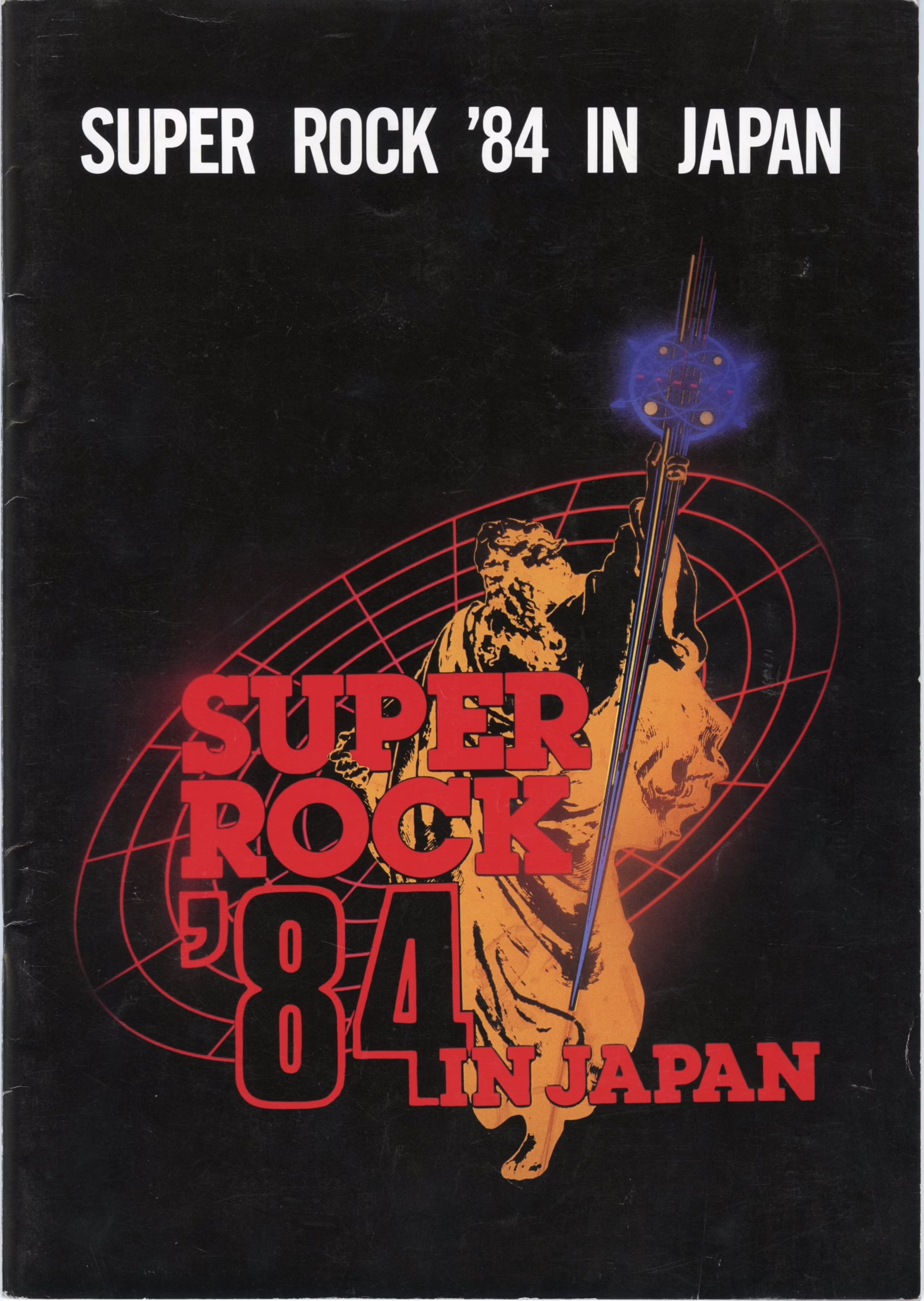
Live From The Vault is Super Rock ’84 Revisited

 DJ Don Edwards
Super Rock ’84 Revisited: How Japan’s Defining Hard Rock Tour Became a Global Launchpad—and Why It Still Powers Live Jam’s “Live From The Vault” Every Saturday Night.
Super Rock ’84 Revisited: How Japan’s Defining Hard Rock Tour Became a Global Launchpad—and Why It Still Powers Live Jam’s “Live From The Vault” Every Saturday Night
There are moments in live music history that don’t just capture a scene—they ignite one. Super Rock ’84 in Japan stands as one of those rare, catalytic events, a touring festival that not only delivered an elite lineup of hard rock and heavy metal acts at their peak, but also redefined how global audiences would connect with Western rock performance in the decades that followed. More than forty years later, its legacy continues to reverberate—not just through the bands it elevated, but through the way live recordings from that era are still celebrated, studied, and broadcast today, including on <a href=”https://livejamradio.com”>Live Jam</a>, where the weekly “Live From The Vault” radio experience transforms these historic performances into a living, breathing archive for a new generation of listeners.
Spanning from August 4 through August 12, 1984, Super Rock ’84 was not a single-site festival but a multi-city touring spectacle that cut across Japan’s major markets, including Nagoya, Fukuoka, Osaka, and the greater Tokyo region. This structure gave the event a unique scale and intensity, allowing fans across the country to witness a lineup that, in retrospect, reads like a masterclass in 1980s rock power. Headlined by Scorpions and supported by Whitesnake, Michael Schenker Group, Anvil, and a then-emerging Bon Jovi, the tour delivered a sequence of performances that would become foundational to the genre’s global expansion.
What made Super Rock ’84 exceptional was not simply the presence of marquee names, but the timing of their convergence. Scorpions were already operating at a high level of international recognition, bringing precision, theatricality, and a commanding stage presence that set the tone for each night. Whitesnake, featuring the unmistakable force of David Coverdale and the blistering guitar work that defined their era, delivered performances that fused blues-rooted swagger with arena-scale ambition. Michael Schenker Group brought technical virtuosity and melodic intensity, reinforcing Schenker’s reputation as one of the most influential guitarists of his generation, while Anvil injected raw, high-energy grit that grounded the tour in pure heavy metal authenticity.
And then there was Bon Jovi—young, hungry, and standing at the edge of global breakthrough. Their inclusion on the bill would prove to be one of the most consequential aspects of the entire tour. Performing in front of massive Japanese audiences, particularly during the closing shows at Seibu Lions Stadium near Tokyo, the band delivered sets that many observers now recognize as the ignition point of their international ascent. The exposure and reception they received during Super Rock ’84 accelerated their trajectory in ways that would soon translate into worldwide chart success, arena tours, and a sustained presence at the top of the rock hierarchy.
The cultural impact of the tour extended beyond the live audience. Select performances were captured and distributed across multiple home video formats of the time, including VHS, LaserDisc, and VHD, preserving the energy and scale of the shows in a way that was still relatively novel for the mid-1980s. These recordings became prized artifacts, not just for fans, but for anyone seeking to understand the mechanics of live performance during one of rock’s most commercially dominant eras. They documented not only the sound, but the staging, the crowd dynamics, and the unmistakable electricity that defined the period.
Japan itself played a critical role in amplifying the significance of Super Rock ’84. By the early 1980s, the country had already established itself as a vital market for international artists, known for its deeply engaged audiences and high production standards. The success of the tour reinforced Japan’s position as a cornerstone of global touring circuits, proving that large-scale, multi-city rock events could thrive outside North America and Europe. It also helped solidify the reciprocal relationship between Western bands and Japanese fans, a connection that continues to influence touring strategies to this day.
The following year’s Super Rock ’85 would attempt to build on that momentum, but it is the 1984 edition that remains etched into the collective memory of the genre. Its lineup, its timing, and its execution combined to create a benchmark that few touring festivals have matched since. It was not just a showcase—it was a turning point, a moment when the infrastructure of global rock touring aligned with a generation of artists ready to dominate it.
Today, that legacy is not confined to archival footage or fading memories. It is actively curated and broadcast through platforms that understand the enduring value of live performance as both art and historical record. On Live Jam, that mission is embodied in “Live From The Vault,” a weekly radio event that airs every Saturday night at 9 PM EST. Designed for listeners of all ages, the program delivers a high-impact countdown of the greatest live recordings ever captured—spanning vinyl, CD, and digital formats—with a focus on authenticity, intensity, and cultural significance.
“Live From The Vault” is not built on nostalgia alone. It operates as a form of performance preservation, elevating live recordings to their rightful place as definitive statements of an artist’s capability. In this context, moments like Super Rock ’84 are not simply revisited—they are recontextualized, allowing audiences to experience them with the clarity and appreciation that only time can provide. The roar of the crowd, the precision of the musicianship, and the sheer scale of the production all translate across decades, proving that truly great live performances are not bound by era.
For Live Jam, integrating events like Super Rock ’84 into its programming is both a celebration and a statement of purpose. It reinforces the station’s commitment to showcasing live music in its most unfiltered form, while also positioning it as a curator of history—one that understands that the past is not static, but something to be continually rediscovered and reinterpreted. Whether it’s the explosive rise of a band like Bon Jovi, the seasoned dominance of Scorpions, or the technical brilliance of Michael Schenker, these performances serve as touchstones for what live music can achieve at its highest level.
As audiences tune in each Saturday night, they are not just listening—they are stepping into a lineage of sound that stretches back through decades of stages, arenas, and festivals. Super Rock ’84 remains one of the clearest expressions of that lineage, a moment when the global language of rock reached a new level of fluency and power. Through “Live From The Vault,” that moment continues to resonate, proving that when music is captured live, at its peak, it never truly fades—it only gets louder with time.