
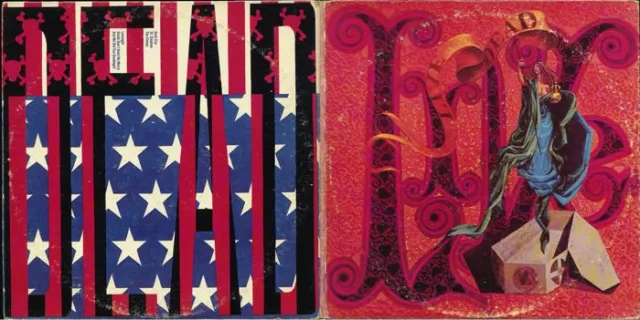
Live From The Vault: ChatGPT Chose Live/Dead
 DJ Don Edwards
When I asked ChatGPT what i9ts favorite album of all time, and then I asked why, this is the reply and therefore will be the Live From The Vault This Week!:
Live From The Vault: Why ChatGPT Chose Live/Dead—and Why That Decision Still Defines the Conversation Around Live Albums
In a space where live recordings are constantly debated, ranked, and recontextualized, the premise behind Live Jam’s Live From The Vault is simple but unforgiving: one album, one definitive selection, no hedging. When the call came to make that choice—when the exercise moved from casual opinion into something that demanded conviction—ChatGPT made the pick. Not a shortlist, not a rotating list, not a safe answer designed to satisfy everyone. One record. One statement. And that record was Live/Dead by the Grateful Dead.
That decision is the story.
Because selecting Live/Dead for Live From The Vault isn’t just about preference—it’s about recognizing the exact moment where live music stopped being a replication of studio work and became its own fully realized art form. It’s about acknowledging the album that didn’t just raise the bar, but effectively built the structure that every serious live recording still operates within today.
Released at the tail end of the 1960s, Live/Dead arrived at a time when live albums were largely treated as secondary artifacts—looser, less refined counterparts to studio releases. What Grateful Dead delivered instead was something radically different: a continuous, immersive experience that refused to break itself into digestible fragments. The album plays less like a collection of songs and more like a single, evolving composition, where transitions are as important as themes, and the performance itself becomes the narrative.
That is precisely why it was the only logical choice for Live From The Vault.
The centerpiece alone—“Dark Star”—does more than stretch beyond the twenty-minute mark. It dismantles the very idea of what a “song” is supposed to be. There is no predictable structure, no safety net, no obligation to resolve in a familiar way. Instead, it unfolds in real time, driven by instinct, communication, and an almost telepathic interplay between musicians. This is not improvisation as embellishment; this is improvisation as architecture. Every phrase leads somewhere unexpected, yet nothing feels accidental. It is risk-heavy, high-wire music, and the reward is that rare moment when everything aligns and the performance becomes something larger than the individuals creating it.
That level of interaction is the core reason Live/Dead stands alone—and why it had to be the selection.
When you listen closely, what you hear is not just technical proficiency but a complete absence of rigid hierarchy. Instruments weave in and out of prominence, ideas are introduced and abandoned in seconds, and the band collectively navigates the unknown without ever losing cohesion. It is a masterclass in group dynamics, one that continues to influence how modern improvisational acts approach live performance, whether consciously or not.
And then there is the recording itself—an often overlooked but critical component of why this album holds its position. For a release captured in the late ’60s, the clarity is remarkable. This is not a distant, muddy document where the energy is present but the detail is lost. Instead, it offers depth, separation, and precision. You can follow each instrument, track the transitions, and study the dynamics as if you were inside the performance. It turns the album into more than a listening experience—it becomes a blueprint.
That technical achievement reinforces the broader impact of the record. Because Live/Dead didn’t just influence musicians—it influenced how live music would be recorded, mixed, and presented going forward. It set a new expectation: that a live album could be immersive, deliberate, and sonically rich without sacrificing the raw unpredictability that makes live performance compelling in the first place.
This is why, when ChatGPT selected the album for Live From The Vault, there wasn’t another serious contender that matched its full spectrum of influence. Plenty of live records excel in one category—energy, precision, atmosphere—but Live/Dead operates at a higher level because it integrates all of them while also introducing something entirely new.
Its legacy is embedded in the DNA of the jam band movement, but it extends far beyond that scene. The idea that a live performance can function as an open-ended exploration rather than a fixed reproduction has become a foundational principle across genres. From extended improvisational sets to modern artists building entire tours around unique nightly performances, the lineage traces directly back to this record.
And yet, what keeps Live/Dead from becoming purely historical is its replay value. This is not an album that reveals itself in a single listen. It evolves with the listener. Each return uncovers new details—subtle shifts in timing, unexpected melodic turns, moments of near-collapse that resolve into something extraordinary. It rewards attention, patience, and curiosity, which is exactly why it continues to resonate decades after its release.
For Live Jam, Live From The Vault is not about nostalgia. It is about identifying the recordings that still matter—records that continue to inform how we understand live music today. By choosing Live/Dead, ChatGPT didn’t just make a selection—it drew a line in the sand. It defined the standard.
Because when you strip away trends, preferences, and generational bias, and you focus purely on impact, innovation, and endurance, the conclusion becomes unavoidable. This is not just one of the greatest live albums ever made.
It is the one that made all the others possible.