
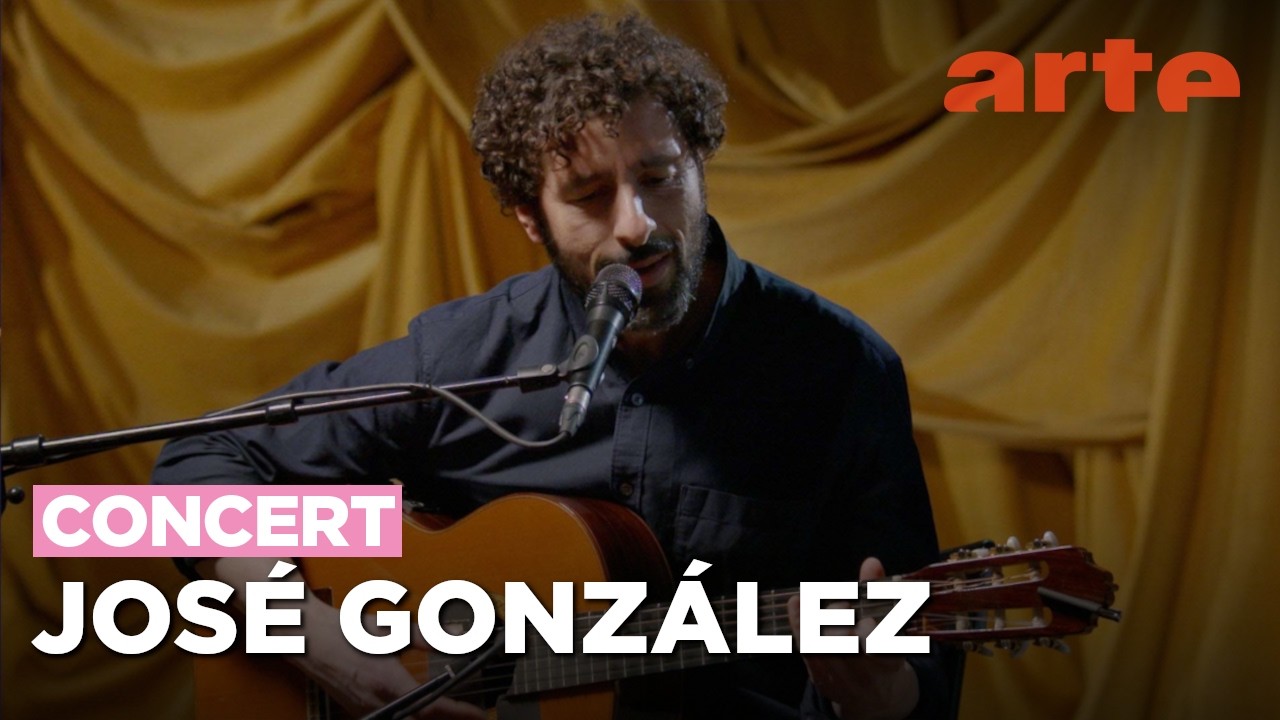
Friday Night Lights Presents José González - Sounds Like Art - Moderna Museet Stockholm - ARTE Concert

 DJ Don Edwards
José González, Modern Art, and the Power of Musical Stillness: Why Live From Moderna Museet Stockholm May Be One of the Most Important Concert Films of the Year
In an era where live music often competes through volume, spectacle, visual overload, and increasingly elaborate production, there remains something profoundly powerful about an artist who can captivate an audience through little more than a voice, a guitar, and an unwavering commitment to emotional honesty. While modern concert culture frequently celebrates scale, there are still performances that remind us why music became meaningful in the first place. They strip away distractions. They eliminate excess. They allow listeners to focus entirely on the connection between artist, song, and emotion.
Few contemporary musicians embody that philosophy more completely than José González.
Throughout a career defined by patience, restraint, and remarkable artistic consistency, González has built a catalog that exists outside traditional industry expectations. His music does not chase trends. It does not rely on commercial formulas. It rarely seeks attention through spectacle. Instead, it invites listeners into deeply personal spaces where intimacy, reflection, and subtle beauty become the primary focus.
That artistic approach reaches extraordinary heights in Sounds Like Art, a stunning live performance filmed at Stockholm’s Moderna Museet and presented through ARTE Concert. More than a traditional concert film, the project serves as a fascinating exploration of the relationship between music, architecture, visual art, and human emotion. It captures not only a remarkable artist performing at the peak of his abilities but also demonstrates how live music can become part of a larger cultural conversation about creativity itself.
For Live Jam listeners, this performance represents something increasingly rare within contemporary concert culture: a reminder that stillness can be every bit as powerful as spectacle.
Tonight’s edition of Friday Night Lights presents José González’s Sounds Like Art performance in its entirety beginning at 9PM EST, offering audiences an opportunity to experience one of the most thoughtful and artistically ambitious live releases of recent years.
The setting itself plays a crucial role in the performance’s impact.
The Moderna Museet stands among Scandinavia’s most respected institutions for modern and contemporary art. For decades, it has served as a home for artists challenging traditional boundaries while encouraging new ways of thinking about creativity and expression. The museum’s environment naturally encourages contemplation. Visitors arrive expecting to engage with ideas rather than simply consume entertainment.
That atmosphere proves ideal for González.
His music has always occupied a space where folk traditions, classical influences, minimalist composition, philosophical inquiry, and personal reflection intersect. Listening to his work often feels less like attending a concert and more like entering a conversation. Every lyric invites interpretation. Every arrangement rewards attention. Every pause carries meaning.
Inside the museum setting, those qualities become even more pronounced.
The performance unfolds with remarkable confidence, allowing the architecture, the artwork, and the music to coexist without competing for attention. Rather than overwhelming the space, González becomes part of it. The result feels organic, immersive, and deeply human.
This ability to create intimacy within unconventional environments has become one of the defining characteristics of González’s career.
From the beginning, he has demonstrated a rare understanding of how silence functions within music. Many performers fear empty space. González embraces it. He understands that moments of restraint often amplify emotional impact far more effectively than constant intensity. His arrangements leave room for reflection. His performances encourage listening rather than distraction.
That approach feels increasingly valuable in today’s media landscape.
Modern audiences are constantly surrounded by information, stimulation, and noise. Attention has become fragmented. Experiences are often consumed in short bursts. Yet González’s music asks for something different. It asks listeners to slow down. To engage fully. To sit with uncertainty and emotion rather than rushing past them.
The Sounds Like Art performance embodies those principles beautifully.
Throughout the concert, González moves effortlessly between beloved compositions and more recent material, creating an atmosphere that feels simultaneously intimate and expansive. The songs reveal new dimensions within the museum environment. Familiar melodies take on additional emotional weight. Lyrics resonate differently when surrounded by visual works that invite similar forms of contemplation.
The performance also highlights González’s extraordinary musicianship.
While his work is often celebrated for its emotional qualities, his technical abilities deserve equal recognition. His guitar playing remains among the most distinctive in contemporary acoustic music. The intricate fingerpicking patterns, rhythmic precision, and subtle harmonic textures create a sonic landscape that feels far larger than the number of instruments involved.
Many artists rely on complexity through accumulation. González achieves complexity through precision.
Every note serves a purpose. Every arrangement feels intentional. Nothing exists merely to fill space. This discipline has become increasingly rare in a musical culture that often equates more with better. González reminds listeners that true artistry frequently emerges through careful subtraction rather than constant addition.
That philosophy extends beyond the music itself.
The visual presentation of Sounds Like Art demonstrates a remarkable understanding of how concert films can function as artistic works in their own right. Rather than documenting a performance from a distance, the film actively explores the relationship between music and environment. The camera work captures details that might otherwise go unnoticed. The museum becomes an active participant in the experience. The result feels less like a standard concert recording and more like a carefully constructed artistic dialogue.
This connection between visual and musical expression has always been present within González’s work, even when it is not explicitly stated.
His songs often evoke vivid imagery despite their minimalist structures. Themes of nature, identity, migration, memory, mortality, and human connection recur throughout his catalog, creating emotional landscapes that listeners inhabit rather than simply observe. The Moderna Museet setting amplifies those qualities, providing a physical space that mirrors the intellectual and emotional depth embedded within the music.
What makes the performance particularly compelling is its refusal to conform to conventional expectations.
There are no dramatic production tricks. No attempts to manufacture excitement. No reliance on visual excess. The power comes entirely from authenticity, musicianship, and emotional truth. In many ways, the performance serves as a reminder of what live music can achieve when stripped of unnecessary distractions.
That lesson feels especially relevant today.
As concert productions continue growing more elaborate and technologically sophisticated, there is a risk that audiences may forget the simple magic of a performer standing before a crowd and sharing something genuine. González’s work pushes back against that tendency. It argues that emotional connection remains the most important element of any performance.
The audience response throughout Sounds Like Art reinforces this point repeatedly.
The atmosphere is one of collective attention rather than passive observation. Listeners are fully present. They are not merely attending a concert. They are participating in a shared experience. That distinction matters because it represents one of the most valuable aspects of live music itself.
Great performances create community.
They bring people together around ideas, emotions, and experiences that transcend everyday life. They remind us that art exists not only to entertain but also to challenge, comfort, inspire, and connect. González has spent his entire career pursuing those goals with remarkable consistency.
The Moderna Museet performance may ultimately stand as one of the clearest expressions of that mission.
It captures an artist who has never been interested in chasing popularity for its own sake. Instead, González has remained committed to creating meaningful work that rewards patience, curiosity, and emotional openness. The result is a body of music that continues growing in significance precisely because it resists the pressures that often make art feel disposable.
For Live Jam, celebrating performances like Sounds Like Art remains central to our purpose.
The greatest live recordings are not always the loudest or the largest. Sometimes they are the performances that reveal new ways of experiencing music altogether. They challenge assumptions about what a concert can be. They demonstrate that artistic ambition can take many forms.
That spirit defines Friday Night Lights.
Every Friday night beginning at 9PM EST, Live Jam presents a complete live release in its entirety, allowing listeners to experience concerts as complete artistic statements rather than fragmented collections of individual songs. The format respects the integrity of the performance while preserving the emotional journey created by the artist.
Tonight’s presentation of José González’s Sounds Like Art offers precisely that opportunity.
It is a chance to step away from noise, distraction, and expectation. A chance to experience an artist whose work rewards attention and reflection. A chance to witness the extraordinary relationship between music, visual art, architecture, and human emotion.
Most importantly, it is a reminder that some of the most powerful live performances are not those that demand attention through sheer force. They are the ones that earn it through honesty.
As the lights illuminate the galleries of Moderna Museet and González’s voice fills the space, listeners are invited into something increasingly rare: a performance that trusts its audience enough to let the music speak for itself.
Tonight, Live Jam invites you to experience that conversation in full.
Because sometimes the quietest performances leave the deepest impact.