The live sector is heading past $50 billion by 2030, even as mid-size clubs feel a real squeeze. Here’s everything moving this week, from a new Apple-owned stage in London to Oasis adding more stadium nights than anyone expected.
This Week in Live Music
Apple Opens a Venue, Gibson Joins Crossroads, and Oasis Keeps Growing
The live sector is heading past $50 billion by 2030, even as mid-size clubs feel a real squeeze. Here’s everything moving this week, from a new Apple-owned stage in London to Oasis adding more stadium nights than anyone expected.
The live music business is on track to clear $50 billion by 2030, and on paper that sounds like an industry in perfect health. The reality underneath that number is a lot more uneven. Stadium-level headliners are still selling out without breaking a sweat, but mid-tier acts and independent promoters are increasingly stuck staring at what insiders have started calling “blue dot fever,” the dread of watching blocks of unsold seats sit empty on a seating chart. Average ticket prices have roughly doubled since before the pandemic once inflation and dynamic pricing are factored in, and that’s exactly the kind of price sensitivity that’s driving a real spike in cancellations for smaller rooms, the 50-to-300 capacity clubs across Europe and North America that have always been where new acts cut their teeth.
That split matters more than the headline growth number. A touring ecosystem only stays healthy if there’s a path from small rooms to bigger ones, and if the bottom of that ladder keeps losing rungs, today’s arena headliners are tomorrow’s problem. Worth watching closely as the year plays out.
Apple has officially opened Apple Music Hall, a brand-new 600-capacity room built into London’s historic Battersea Power Station, directly beneath Apple’s UK headquarters. Doors open September 28, and this isn’t just a room with good sound, it’s a fully wired production facility built around sixteen-plus cameras, professional broadcast capability, and iPhone capture working side by side. Artists playing intimate sets here can record in Spatial Audio and walk away with a broadcast-ready mix the same night, and performances will stream globally so Apple Music subscribers outside London aren’t left out.
The venue also shares space with Apple Music’s new London radio studio complex, which becomes the hub for all of the service’s UK-based hosts and shows going forward. It’s Apple’s first real return to physical event branding since it shut down the iTunes Festival back in 2017, and the timing is notable: London lost 45 independent venues last year alone, and now a company with Apple’s resources is stepping directly into that same brick-and-mortar space, for better or worse.

Gibson is partnering with Eric Clapton’s Crossroads Guitar Festival for its return to Texas, running Saturday and Sunday, September 26 and 27, at the Moody Center in Austin. Saturday’s broadcast kicks off at 5:30 PM Central, Sunday’s at 4:00 PM Central, and the bill across both nights is stacked: Clapton headlines both, with Joe Bonamassa, Gary Clark Jr., Buddy Guy, John Mayer, Trey Anastasio, Pete Townshend, and Tedeschi Trucks Band all confirmed. Gibson is bringing its own roster of signature artists into the mix too, Bonamassa, Clark Jr., Billy Gibbons, Sierra Hull, Marcus King, and Keb’ Mo’, plus a festival booth stocked with more than thirty Gibson and Epiphone instruments and MESA/Boogie amps that fans can actually plug in and play.
The real collector’s moment is the first public preview of the Epiphone Inspired by Gibson Custom Eric Clapton 1964 ES-335 TDC Reissue, modeled on the original guitar Clapton played during his Cream years, with the reissue itself due in summer 2027 and a chance to win one on-site. This is the festival’s seventh run, marking the 28th anniversary of Crossroads Centre Antigua, the addiction treatment and education facility the event has always existed to support, with Gibson Gives continuing that funding relationship and Guitar Center returning as retail partner and putting the original 1964 ES-335 on physical display. Tickets are running through Ticketmaster and Live Nation, and for anyone not making it to Austin, a free livestream will also be available.
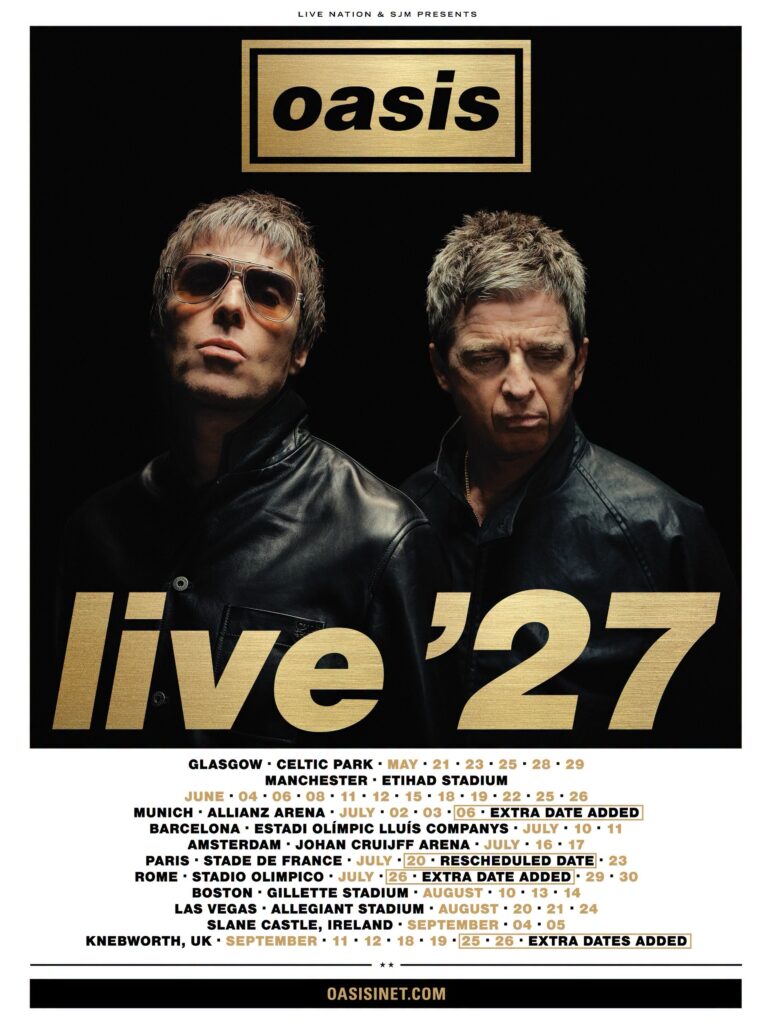
Oasis has tacked four more stadium dates onto their already massive “Live ’27” world tour, pushing the total run to 42 shows across Europe and the United States. Promoters are pointing to “phenomenal demand” during the tour’s pre-registration window as the reason, and the new dates include a third Munich night at the Allianz Arena on July 6, a third Rome night at the Stadio Olimpico on July 26, and a fifth and sixth night at Knebworth House on September 25 and 26, which now officially closes out the entire tour.
Paris fans are getting a scheduling shuffle rather than an addition. The band was originally booked at the Stade de France on July 23 and 24, but long-planned railway works between Île-de-France and Hauts-de-France landed directly on the 24th, and the regional Prefect stepped in over transit and safety concerns, pushing the stadium operator to deny that date. Rather than lose the show outright, promoters moved it forward to July 20 and 23. Registration for the tour is now fully closed, and anyone who registered will get a non-transferable code for a tightly controlled sales window rather than open sale.
Switzerland’s Montreux Jazz Festival just field-tested something genuinely new: a two-way livestream that turns remote viewers into something closer to actual attendees. The festival’s audio-visual arm, Montreux Media Ventures, built the system after watching livestream viewership jump 324 percent, and prototyped it live during a Vulfpeck set. The project, called IFeL, short for Immersive Festival Live, Remote Presence at Scale, was developed with the Society of Motion Picture and Television Engineers, MIT Reality Hack, the BBC, ITV, and audio manufacturer Shure, and is being shown off at IBC2026 in Amsterdam.
The mechanics are the interesting part. Remote fans wear VR headsets to look into the venue, while performers and on-site fans wearing AR glasses can look back out and see those remote fans’ avatars populated directly into the crowd in real time. Custom Shure ambisonic microphones handle the audio side, so if a remote viewer shifts their virtual seat, the entire mix reshapes itself to stay accurate to that new vantage point, backed by 180-degree onstage cameras and 360-degree rigs planted inside the physical crowd. It’s early, and prototypes rarely ship exactly as demoed, but it’s a real attempt at solving the thing every livestream has always struggled with, actually feeling like you’re there.
Every Friday at 9 PM EST, Friday Night Lights hands the show over entirely to one live release, played start to finish. Tomorrow night, that’s:
This Week’s Spotlight
Goo Goo Dolls at iHeartRadio Music Festival 2026
Some bands headline festivals for decades before ever landing on this particular stage. The Goo Goo Dolls made their first-ever appearance at the iHeartRadio Music Festival this September, and judging by the reaction inside T-Mobile Arena, it was worth the wait. Ryan Seacrest introduced John Rzeznik and Robby Takac by calling their signature song one of the greatest ever written, a bold way to open a set, and the band spent the next several songs making a genuine case for it.
Tune in Friday at 9 PM EST and catch the full set here.